Showing posts with label concepts. Show all posts

Sunday, July 28, 2013

Did you Know?


This is a series of posters titled, Did you know? containing interesting facts about Buddhism or BLIA or YAD. The idea was initiated by the fact that the dining hall has Chinese calligraphy paintings on the walls and many of the participants cannot read Chinese, so we were to make an English replacement for the walls that would be equally interesting for them to read.

The difficulty here was finding a font that would be appropriate and easy to read. The poster is placed fairly high up and the text varies in length.

In the end, due to the fact that the English language takes up 2x the space that Chinese characters do, we doubled the width of the posters and added some colour to make it look less serious and more fun.


Thursday, July 18, 2013

IBLYARC Stage


A stage decoration was asked for two events during the conference, the Welcoming Dinner and the Buddha's Light Night. They wanted something that said, "Hey, look, we (Toronto) are your hosts, but we are happy you (any other city, Canadian or American) are here too with us." without looking nationalistic (via hanging a big flag) and looking like a political campaign. 

So I set to create a cityscape that held icons from each participating city in the conference. From left to right: Dallas (Tower), Orlando (Disney), Edmonton (City hall), New York (Liberty), Toronto (CN tower), Montreal (Biodome), Vancouver (Totem pole), Fremont (City hall), and Los Angeles (Hollywood).

Construction first draft

Construction took a while to figure out. We wanted something that wouldn't take up too much stage space and wouldn't fall over when people are dancing on stage. In the end we built everything out of foamcore and supported it with wooden posts and bags of rice as weights. A light ran between the skyline and the buildings to create extra depth and shadows.


Monday, July 8, 2013

Luggage tags

The accommodation team needed something that would allow us to identify and separate luggage from different cities so when they transport them from airport to hotel so it doesn't get confused in the shuffle. I made the luggage tag only under the instruction of "make me a luggage tag" so I drafted one up quickly. Meanwhile another team felt that the tags were not suited to their needs, so we made a second type that was 17" long and had each individual's last name written on it. Later we also colour coordinated the tags with a coloured ribbon for easy sorting. A specific colour for each city.

drafts


Thursday, June 27, 2013

IBLYARC handbooks


A series of covers were made for the conference handbook. The handbook holds the conference schedule, rules and regulations, and all sorts of handy information. I assumed there would be a little more freedom with the design so I threw some more fun ideas into the mix.

In the end, none of them were chosen and a cover made for the sponsorbook was revamped for the handbook.

Monday, June 17, 2013

Sponsorbook sketchbook pages


Working on a hunch for a background for the sponsor pages. A light image of the youth working together, happy and collaborating, and on top, are our sponsors, helping us make it happen.

Friday, June 7, 2013

Conference souvenirs - backpack

One of the souvenirs for the conference is a drawstring backpack. These are handy because participants have stuff to hold like their schedule, notebooks, pens, waterbottle, and etc.

I suggested tote bags, but tote bags are apparently girly, so we went for backpacks. Finding a good supplier who can get us a good quote for such a small volume was one of the biggest difficulties here. Second was finding a cheap canvas or cotton tote, rather than going for that wishy-washy weird-feeling waterproof material. Nonetheless we found one in the states and got it shipped to us JUST IN TIME for the conference.


I made four options to choose from. The bag was requested to be in a red colour, and the more colours you screenprint the pricier it gets so I kept everything white.

Final decision! We went with this one!


Tuesday, June 4, 2013

A passport stamp


For each conference, a stamp is stamped into the participants' YAD passport marking their attendance to the year's conference. I was looking to make something very immigration-like. A play on the fact that it is a "passport stamp". 

However, in execution, the reality was that there were size constraints, cost constraints, and even shape constraints on the stamp. Plus, the text could not get too small or else they will turn into a blob..especially Chinese characters. 

What's neat was that I worked with a stamp-maker remotely through online video chatting and screensharing as we shared my ai file. Technology these days! I was pretty impressed since my own skype can't really hold a stable connection on most days.


Tuesday, May 21, 2013

Conference souvenirs - USB

swag!
The main souvenir for the conference is a USB. We opted for something that felt useful and wasn't something that somebody would want to throw away when they got home. At the end of the conference we're going to put photos, a video summary, and useful documents used during the conference on the drive so participants can take them home and share it with their subdivisions for future use or reference. 

Green is the main theme colour, but the organising committee head has a strong affinity with the colour red so the resulting USB graphics were in red afterwards. 

Thursday, November 8, 2012

Day 2: Meeting our friends from Kasese online

This morning we had an online meeting with some people in Kasese:
Peter – in charge of KADUPEDI
Phestus – Youth coordinator at KADUPEDI
Robert – a friend of Navin
Kio – builds tricycles

Using Skype, we all crammed ourselves into the webcam’s view. “We” consisted of:
The students: Andrew, Alyssa, Ruby, Carmen
The guests: Noel, Aaron
The SID: Bjarki
The READ Institute: Dean, Dale
CanUgan: Navin

This was our first official meeting with them so we were all very excited. We did a short debriefing of who the meeting should generally pan out. Within minutes we were connected and having hello at one another. We introduced ourselves and got to ask them questions relevant to our project focus. I didn’t really prepare properly because I assumed we were sticking to the questions we had emailed them earlier so I had difficulty asking the right questions when it was my turn. I was concerned about trying to ask open ended questions yet still addressing important information that would be relevant to my project rather than asking for validation of a project or an idea. (ie. Should I design this for you, do you / would you like… ) How do you design WITH someone if you just offer them things from a vague idea of something you're not even entirely clear about? All of that was going through my head while trying to think on my feet asking questions at the same time. Finally someone was like, "Just tell them your idea" so I started again and with an understandable example they could give me real feedback I told them about power exchange and tools with the trike in a brief manner and they said they know about it and had wanted to put it into practise, but has never done it (yet). That's a green light! (and wasn't so hard was it)

What I need to learn:

  • How to frame questions properly
  • Use easy examples
  • Speaking using non-technical terms (is drivetrain a technical term?)
  • Asking to repeat if you can't hear clearly
  • How to talk to people who aren't in science or design
  • To remember that it's neither we nor them, but us

One thing that was interesting to note, however, was a comment from Kio, the manufacturer, who asked us what was wrong with the current tricycle, because in fact, it's 85% improved. We don't want to go there and tell him that his parts are wrong and that we can do better because we know better and therefore he should make our designs instead. That also isn't our goal at all. So there is some rethinking to do to close the gap of miscommunication between us.

At the end of the call, Aaron and Noel gave feedback at the end of the call. I think that's a good habit to pick up. (end of event summary/review) Or perhaps it is easier to provide suggestions as an observer rather than a participant.

Items noted:

  • Should keep building the relationship between students and Kadupedi/Kio - make a call schedule
  • Mail things over now - create a physical exchange and see how long it takes to arrive
  • It's really important to create a good relationship, this allows for the ease of either party to speak freely and to understand each other's nuances
  • Include tricycle riders in the design process and not just the manufacturer
  • Consider compensation for expertise


In the afternoon we attended a TSES lecture by Aaron Wieler from Whirlwind Wheelchairs about the journey of design and fabrication in the world of wheelchairs (in/for developing countries) while his buddy Noel doodled his way through the lecture on-screen, live.

Thumbs up for class.

 
In the lecture, Aaron shared anecdotes of his previous work and process. In this field, his design framework consists of appropriate technologies, co-creation, participating development, and creative capacity building. One of the key things was to always ask questions and listen
"Even when you're feeling hot and sweaty and you just want them to tell you they like the wheelchair, you need to ask questions about their mobility needs/solutions vs "Hey, do you like this?". Also, don't be afraid to put yourself out there. Crowdsource! There are lots of answers that can come through that may be really helpful." 
His second takeaway point was to always keep your assumptions in check. Don't let your assumptions keep you from asking for real feedback, and lay them out so you can address them without having them secretly dictate your user research and design without knowing.

In the evening, we attended the Peeter Kruus Memorial lecture held by Noel Wilson, from Catapult Design. The topic was 'The Joys and Challenges of Designing with Social Intent'.

Here, Noel took us through his work at Catapult, a "socially motivated" design firm. That means (without being too idealistic) that they try to help people at the bottom of the pyramid thrive through design and at the same time help clients bring their products to market. He gave us a list of tips for overcoming the challenges of designing with social intent. I don't have the complete list, but here's most of it.
  1. Roleplay - wigs help
  2. Storify - make good stories
  3. Break your prototypes - For heaven's sake, it's a prototype!
  4. Iterate - become intimate with your product
  5. Co-create - you may not always have an answer but maybe the result is just the relationship
  6. Iterate.
  7. Manufacture - know your capacity and limits
  8. Iterate.
  9. Pilot - Take it out and give it a run


And that's a wrap! Long day innit?
My team and I have been busy being happy sponges, absorbing as much as we can as quickly as we can. Usually our brains are gone by the end of the day so I can imagine our two new friends from San Francisco must be equally tired if not more. Goodnight!

Monday, October 22, 2012

IBLYARC Logo

A few months ago, I was asked to help lead the Art and Design team for the IBLYARC (International Buddha's Light Young Adult Regional Conference) held in Toronto this year. This is a fairly big project, containing (and will probably grow), a logo, posters, banner, souvenirs, all print media, handbooks, signs, stage decoration, all event decorations, and etc. And not just designing everything, but getting the right suppliers, people to help with production and logistics of everything coming together, looking good and being on time. (August 2013)

Illustration isn't my thing, I'm an industrial designer I say, not a graphic designer, but I took the proposal anyway seeing it as mini side project for myself and creating a temporary brand identity package for a five day event. It could be fun!

There are a few key items that were important in the making of the logo:
1. The theme is "From the ground up" and so it should play on that
2. Strike a balance between both a traditional and modern idea at the same time. (The temple being very traditional and the youth bringing it's modern touch)
3. Don't look the same as the Toronto youth conference in 2005!
4. Simple, clean, versatile because we'll need it on everything and everywhere

Below are the concepts from my team:

1. A lotus root. The seed of a beautiful flower, which grows from the muddy ground, up and out!

2. A ladder means you go up, a snake means you go down.

3. A calligraphy dot. A single calligraphy stroke begins and ends with a dot. 


Sunday, September 30, 2012

Que

Part of the mini storyboard for my minor class. "..And then she screams"

Friday, September 21, 2012

milkbag

Working on a sound sketch logo for class. Milk..BAG

Saturday, October 2, 2010

P2.2 concepts

Pick a concept and run with it.

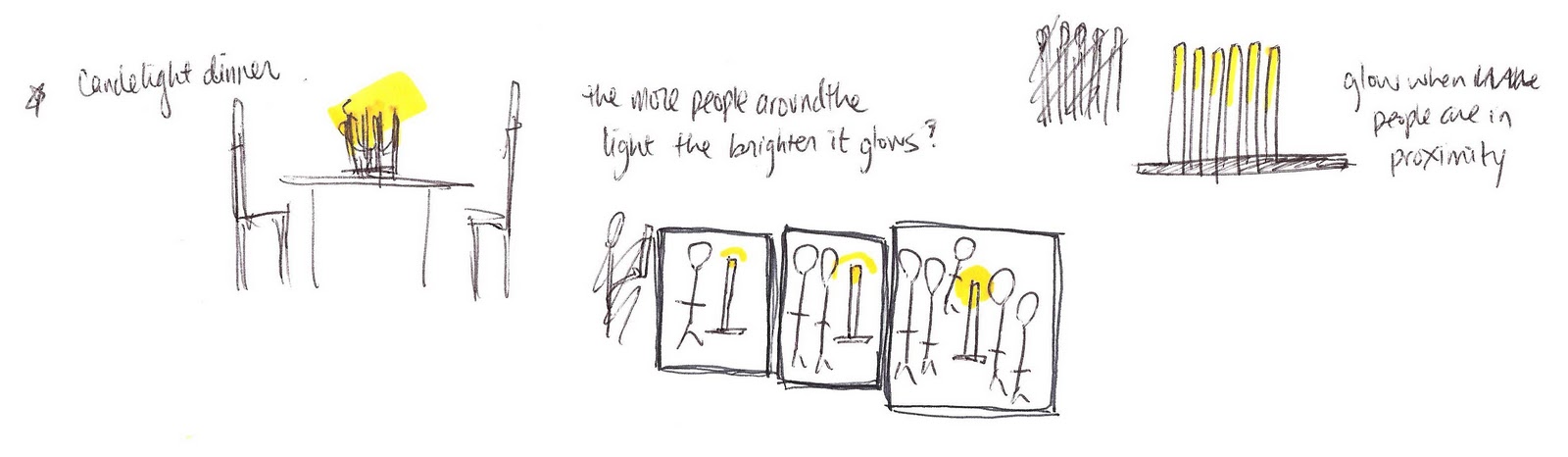
I chose the interactive lighting one because I felt that I had the most flexibility with it. There were so many possibilities with the interaction, and features, and it was different from other projects I’ve done, and it seemed fun. Plus, I’ve never done anything interaction experience-y.
So, just some details to figure out.. I know what it’s supposed to do, generally, but how? And what is the experience going to be like?


Wednesday, September 29, 2010

P2 Concepts

Here, we start with initial concepts, inklings of ideas that are further pushed into development if they are interesting. We had to have 12 pages of concepts in one week. Most people ignored the challenge thinking the prof wasn’t going to check. I did them, tiny little doodles each, I’m glad because the TA eventually came around to check.
With lighting as the theme, I wanted something that was playful, interactive perhaps, and could a story. Anyway, after a whole bunch of lame ideas, these were the final few.

influences: family dinner, Philips wake-up light.

Interactive ambient lighting experience

Childrens night lights to help them feel secure and sleep at night


wind powered ourdoor light. Light variations by the strength of wind 

I chickened out on the presentation, and didn't do the work by hand. I figured it would be cleaner on the computer, but this wasn't what I imagined either. It's a bit too stagnant,a little cold. My roomate reprimanded me and said for all that time I spent working it out and drawing and tracing and digitizing, I could have spent on doing it decently by hand. Perhaps...

But! As I am undeniably shy and self conscious about my sketching ability, my prof actually complimented me (!) saying that my way of drawing was totally okay although very different from other students in the class (who do great drawing if you saw it) because it is simple and still understandable and therefore still efficient. I don’t know if he was just being in a good mood, but that was uplifting. Even best-class-sketcher said he loves the way I draw, says it’s very me. Way to make my day.

Thursday, September 23, 2010

P1 research: Design a small mobile low voltage light

There are 8 topics: Major retail, Industrial products and trades, Innovation, Ethical opportunities, Battery technology, Bulbs, Alternative energy, and Construction and mechanical construction. My group was placed in the Innovation category.

So, what breeds innovation?
Here, looking at what's already been done, people pushing boundaries and the potential with new materials and technologies, there's so many exciting possibilities for concept development! One possible objective was making a light that was dark sky friendly. Something that won't create light pollution and be too harsh, but it would be enough to be usable and at the same time not just for dim ambient purposes.

I also really enjoyed discovering the Solskin, designed by Hrafnkell Birgisson. It involves an old icelandic folk tale as the inspiration for the product. I love stories!

Is this process effective?
We are such visual learners, we learn first with our eyes and making mental patterns, and second we learn with our hands. Sometimes, it's the other way around. Anyway, as simple as it may seem to categorize information who are we to judge what belong where. Sometimes we disagree, but in the end, the product still ends up somewhere on the board under some category. Which are our core values? What are the constraints we want to keep and which ones can we be flexible with? Is this helping us build better connections? This map got wiped out and redone at least four times. I'm not sure if we agreed on every iteration, but maybe it was the process of experimenting with different categories and rearranging them to understand them in other contexts were we able to make the clutter more understandable for us and others.