Project A has finally started, and with a bang!
A double back-to-back session and five meetings in two days with our client. I haven't been in the office since Tuesday and I miss the team!
We had a good kickoff. I was prepared because we've been preparing for weeks now. It's always interesting to find what kind of client and dynamic we are going to have. Nonetheless, still feeling uber stressed. I have not figured if it's because I'm hungry or stressed, but there was a night I couldn't sleep and every night thereafter its just nerves in my belly. I believe it's due to inexperience, so more future sessions later means less stress. We also had our first working session the following day, which was tiring but nice because the content was fresh for our participants. We also changed our style a bit this round and I really feel it just keeps improving each time. It's also the first time I'm really preparing the sessions on my own so it was a lot of brain work figuring flow and making sure we find the easiest way to facilitate co-creation.
I wish I can speak to this work in a snap. Every time I need to speak I'm afraid they'll think I'm a fraud. (see, imposter syndrome and then the Dunning-Kruger effect)
Project B started too, and our first session with them is next week. This one scares me as well, we'll be in a room full of really smart individuals, so what am I to say that they don't already know better? The work is also in an industry I know almost nil about. So maybe some market research and understanding processes and how businesses run will help alleviate the fear.
Project B had deadlines this week too, and we're just getting to know the team as well. We worked until super late. We're swamped.
Balancing two big projects isn't easy.
I'm looking for tools that will help me stay organized and focused. So I'm thinking either meditation or evernote. Something digital or analog? Not sure. Our project team also shrunk from three to two and the lead has two/a heap of other projects/responsibilities so it's on me to step up my game and take care of my part so they don't have to worry/waste extra time teaching vs doing. My goal is to be able to say "let me take care of it" and him not have to worry. Taking more than I can handle? This is probably why my stomach is in knots.
Showing posts with label update. Show all posts
Showing posts with label update. Show all posts
Friday, May 15, 2015

Thursday, October 16, 2014
New stuff-- portfolio B-SIDE

I've been working on a side-b of my portfolio website. I find that my professional portfolio is very serious, and a bit square, and I wanted people to know that not only is it true that I can think critically when solving issues at hand, but I also have a fun and creative side too.
Thursday, June 13, 2013
Graduation

That's it! Four years (five including a year abroad) ago just classmates and now pretty much family.
Woohoo! Also, I found out that Wonjoon was fooling me the entire time in second year about failing students T_T
Sunday, April 28, 2013
CAAS Conference
My team and I are participating in the CAAS (Canadian Association of African Studies) conference hosted by Carleton University this week with our project. The topic is: Communicating Social Innovation; Co-developing New Products for the Disabled. Two of our friends from Uganda will be arriving tomorrow, so it will be nice to see their faces again.
For the roundtable discussion, we hope to cover:
1. How to improve communication in the co-development process?
2. How PWD’s (people with disabilities) in Uganda are not only looking for mobility aids, but also a way to gain more economic independence through the use of better mobility aids.
3. Communicating through physical prototyping and the branding of ideas. How to sustain innovative ideas and commercialization of such ideas.
I need to go do some prepping, but I hope I'll be able to share the good insights with you in a few days time!
For the roundtable discussion, we hope to cover:
1. How to improve communication in the co-development process?
2. How PWD’s (people with disabilities) in Uganda are not only looking for mobility aids, but also a way to gain more economic independence through the use of better mobility aids.
3. Communicating through physical prototyping and the branding of ideas. How to sustain innovative ideas and commercialization of such ideas.
I need to go do some prepping, but I hope I'll be able to share the good insights with you in a few days time!
Thursday, March 28, 2013
presentation plans
The final presentation is in less than a week. I've been thinking about it for a few days now, and it's strange how much it baffles me on how to present everything I've learned in only ten minutes. Not only that, but I have no idea where to start. It's been such a long eight months! I made a linear 'speech structure' but I can't figure out if one should start their presentation with the final result and work backwards, or start from the beginning and then show the final result. The work is not linear, A did not lead to B, necessarily, so I re-did my plans and made a bubble instead. I wonder if I can present in a non-linear way and people will still understand me...


Monday, March 25, 2013
Figuring things out

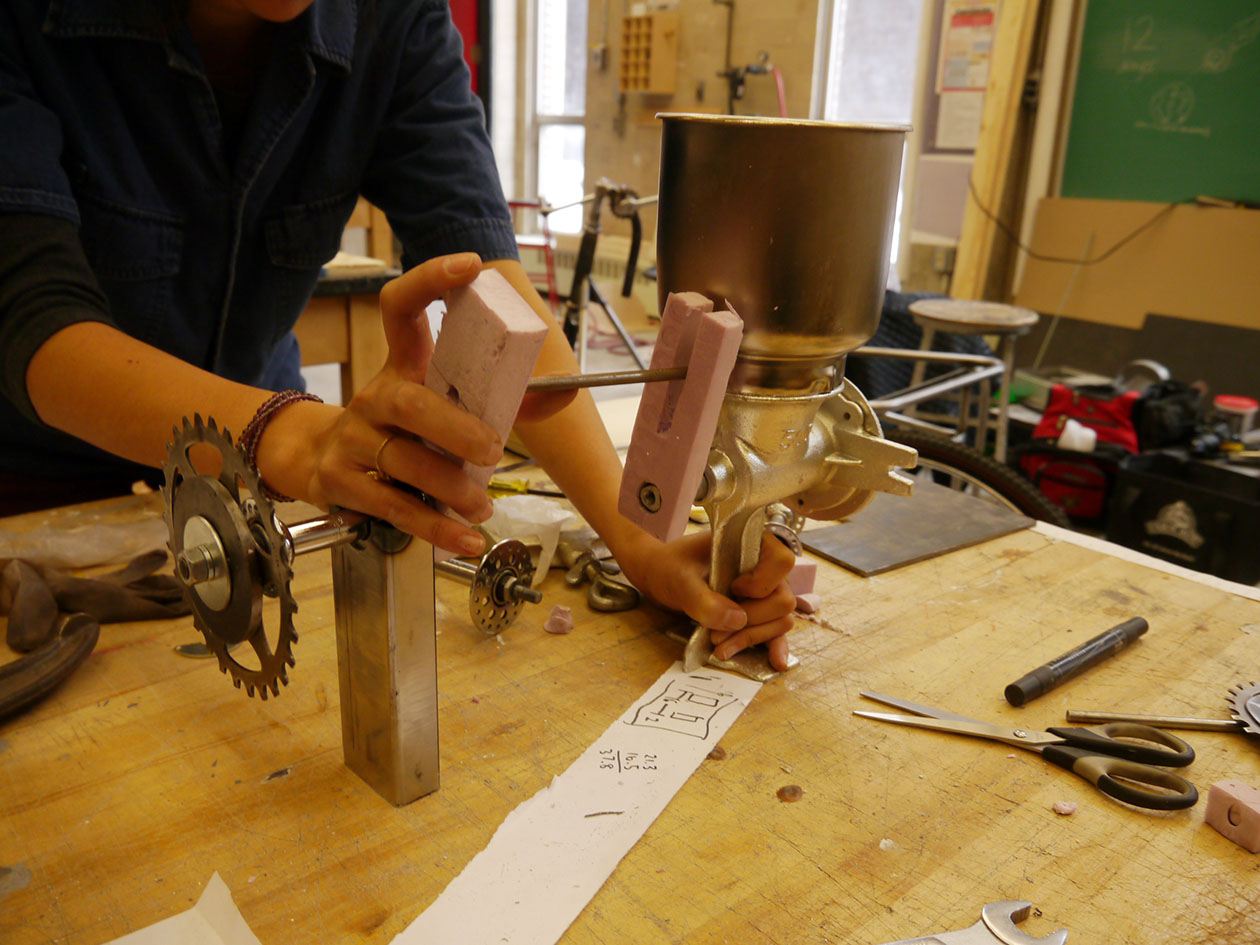
I'm getting into a good routine now, waking up super early and getting to work when it's all quiet and the residue of the day doesn't weigh you down. Still lots of work to do though, but it's getting done. I'm in the process of building a new connector that works similarly to a universal joint, because the one I prototyped for Uganda had alignment issues that could not be resolved by Kio, our welder. Hopefully this one will work better! (In theory, it does)
Anyway, proof that I'm actually working:

Wednesday, March 13, 2013
Final model begins

Today's problem: Finding a thick large sprocket with a small hole.
Onward ho!
Thursday, February 7, 2013

Saturday, February 2, 2013

Thursday, January 31, 2013
update

I've practically been camping out in the metal shop for a week and a half now. There are a lot of small alterations to the maize mill that need to be done in order for it to work and we've been attacking each little problems as we approach them. The simplest way is to weld steel to the cast iron mill but nobody knows if it's a safe idea, that the iron will not turn so brittle that it will crack under the torque produced by the system I'm building. I'm pretty sure when I bring this to Uganda they can do everything I've done, but in two days time with some extra African ingenuity. However, on an exciting note, with a few more cuts on the lathe and some welding and this baby will be ready to grind!
Wednesday, January 23, 2013
Informal mid-crit review

1. Concept validation, and 2. My plan, and 3. My goal
Since we are leaving together to Uganda quite soon, I really wanted to make sure everybody (ie. profs and advisors) was on board with the idea, and my choices.
Thursday, January 17, 2013
Shelling
The maize process goes something like this:

Here's some basic 'ancient' technology on shelling and husking:

Corn sheller wtih an engine, http://www.old-engine.com/keystone.htm
Patented sheller, 1877: http://www.americanartifacts.com/smma/sheller/goddard.htm
Common cast iron sheller, http://www.strombergschickens.com/product/hand-crank-corn-sheller/feed-mills
Extras:
Corn shelling in action: http://youtu.be/z6iXViuw24o
A cool and inspirational sheller by GCS: https://www.facebook.com/video/embed?video_id=10150323945951671
Friday, January 11, 2013
No answers, just more questions

Today, we had a good session with our client, and we reviewed the project thus far and discussed what was next. We made a chart to mark a list of our priorities and our to do list. It seems I need to add some elbow grease. I've been spending my time trying to create an attachment part from the tricycle drivetrain for the tool, when perhaps I should be focusing on the tool first. Because maybe that attachment part isn't as necessary as I believed it to be. Of course, my research proves that indeed pedal power > single hand power, but under what varying variables? There are assumptions I have had to make in order to move forwards, and as a result, I have a good hypothesis, but a potentially wrong direction. And at the same time perhaps I was just solving a technical challenge and not really doing any design work.
So at the end of the day, back to the drawing board, does the benefit of the idea outweigh the cost of the part?
Monday, January 7, 2013
ideas


plus a shaft, plus a mill...voila?
Thursday, January 3, 2013

Thursday, December 27, 2012
ChocoSol


Electric assist

Grinding by hand

Tension adjustment and leather chain


vaccuum pipe filled with cement as a flywheel

bolted in
For the record, the chocolate is really tasty.
Monday, November 12, 2012
Prototype vs prototype
Our (Team Harambee's) hard work vs (Team) Aaron's hard work:
Neither is perfect, but both have some definite learning points. Alright, aaaaand back to work!
Neither is perfect, but both have some definite learning points. Alright, aaaaand back to work!
Friday, November 9, 2012
Day 3: Final advice


1. When communicating, especially when not in person, double check your english.
- Make sure it is clear with simple sentences
- Use point form when you can so items can be easily addressed
- Don't put multiple questions in one sentence
2. When testing protoypes and getting feedback from users...
- Keep in mind that they will point out the obvious before understanding the nuances of the product
- Compare initial perception of product with how long they get to try the product
- Fit and finish (or lack thereof) can be distracting
3. Try to explain what you do in eight words or less
- Look at your general context and narrow it to a focal context
- Link people with processes
- Line up assumptions and list your unknowns


One of our group members took advantage of the short time we had and turned the trike into an impromptu vendor cart trying to sell coffee to passerbys just to get an idea for what it may feel like.

The past three days have been exhausting but really great. Noel and Aaron are wonderful mentors. They are really great listeners and are open and accepting. I also think that's what makes them good at what they do. Having the two of them together was super. One brought a 'How to design and think in this context' mindset while the other provided a 'this is how it is built and why' angle to the table. The marriage of their expertise from experience was really valuable to our team. It was like a knowledge and support power boost! Many thanks to Noel and Aaron for coming up here to Ottawa!

Thursday, November 8, 2012
Day 2: Meeting our friends from Kasese online

Peter – in charge of KADUPEDI
Phestus – Youth coordinator at KADUPEDI
Robert – a friend of Navin
Kio – builds tricycles
Using Skype, we all crammed ourselves into the webcam’s view. “We” consisted of:
The students: Andrew, Alyssa, Ruby, Carmen
The guests: Noel, Aaron
The SID: Bjarki
The READ Institute: Dean, Dale
CanUgan: Navin

What I need to learn:
- How to frame questions properly
- Use easy examples
- Speaking using non-technical terms (is drivetrain a technical term?)
- Asking to repeat if you can't hear clearly
- How to talk to people who aren't in science or design
- To remember that it's neither we nor them, but us

At the end of the call, Aaron and Noel gave feedback at the end of the call. I think that's a good habit to pick up. (end of event summary/review) Or perhaps it is easier to provide suggestions as an observer rather than a participant.
Items noted:
- Should keep building the relationship between students and Kadupedi/Kio - make a call schedule
- Mail things over now - create a physical exchange and see how long it takes to arrive
- It's really important to create a good relationship, this allows for the ease of either party to speak freely and to understand each other's nuances
- Include tricycle riders in the design process and not just the manufacturer
- Consider compensation for expertise


Thumbs up for class.


In the lecture, Aaron shared anecdotes of his previous work and process. In this field, his design framework consists of appropriate technologies, co-creation, participating development, and creative capacity building. One of the key things was to always ask questions and listen.
"Even when you're feeling hot and sweaty and you just want them to tell you they like the wheelchair, you need to ask questions about their mobility needs/solutions vs "Hey, do you like this?". Also, don't be afraid to put yourself out there. Crowdsource! There are lots of answers that can come through that may be really helpful."
His second takeaway point was to always keep your assumptions in check. Don't let your assumptions keep you from asking for real feedback, and lay them out so you can address them without having them secretly dictate your user research and design without knowing.

In the evening, we attended the Peeter Kruus Memorial lecture held by Noel Wilson, from Catapult Design. The topic was 'The Joys and Challenges of Designing with Social Intent'.


Here, Noel took us through his work at Catapult, a "socially motivated" design firm. That means (without being too idealistic) that they try to help people at the bottom of the pyramid thrive through design and at the same time help clients bring their products to market. He gave us a list of tips for overcoming the challenges of designing with social intent. I don't have the complete list, but here's most of it.
- Roleplay - wigs help
- Storify - make good stories
- Break your prototypes - For heaven's sake, it's a prototype!
- Iterate - become intimate with your product
- Co-create - you may not always have an answer but maybe the result is just the relationship
- Iterate.
- Manufacture - know your capacity and limits
- Iterate.
- Pilot - Take it out and give it a run
And that's a wrap! Long day innit?
My team and I have been busy being happy sponges, absorbing as much as we can as quickly as we can. Usually our brains are gone by the end of the day so I can imagine our two new friends from San Francisco must be equally tired if not more. Goodnight!
Wednesday, November 7, 2012
Three day knowledge transfer - Noel Wilson x Aaron Wieler
We have three days with these two guys from San Francisco. There was so much we learned compacted in a single day that when I got home at night I had to write everything down in fear of forgetting it. Report writing / story writing is a good skill I suppose, so perhaps this post will come in handy some day, if not just to jog my memory.
 First, we introduced ourselves, and the project in general, and then each of our individual focus in the project. They then asked us how we came to our project focus --What are our motivations?
For Andrew, it was innovative opportunities through income generation via the tricycle
For me, it was to increase the bicycle (drivetrain) power to do other things
For Ruby, it was to increase accessible mobility through extended mobility
For Alyssa, it was sustainable development through addressing manufacturing methods and standardisation
 Second, they gave us feedback and useful resources to check out.
In terms of "bicycle power":
 Third, they addressed the multiple-agenda holders in the project. This was a scary looking list (because it was so long) but it was really good to see what we (as students) need to fulfill and what are the expectations of others. They also pointed out that we needed to be realistic about our time boundaries. (An 8-month project) and that being said, what do we want from it? "You need to be a little selfish" one said as the other nodded in agreement. "One time when I was hired," Noel began, "My manager asked me what I wanted out of the job, and I gave her my answer. Good, was her response, I don't like to keep/hire people who don't know why they're here or what they want." So make sure you know what you want and communicate it to others so there is a level of transparency throughout the process --that'll help make things easier.
 Fourth, Aaron brought in a prototype he was working on. For students, a prototype usually ends up looking more like a crap-up, so when he pulled his tricycle-wheelchair FLAT PACKED out of a box everyone just went starry-eyed. We put it together under Aaron's directions and asked him questions along the way. Why some parts are like this, and why features are that. He talks a mile-a-minute but we learned a lot about the small details of the design of a wheelchair-tricycle. Once it was together, we took it outside, had a quick orientation and then hand-pedalled off into the night.


A new understanding of wheelchair-tricycles: increase gain of +10 points
*Thanks to Ruby for her photos
**Thanks to Aaron for bringing his prototype all the way here and letting us learn from it!
For Andrew, it was innovative opportunities through income generation via the tricycle
For me, it was to increase the bicycle (drivetrain) power to do other things
For Ruby, it was to increase accessible mobility through extended mobility
For Alyssa, it was sustainable development through addressing manufacturing methods and standardisation

In terms of "bicycle power":


A new understanding of wheelchair-tricycles: increase gain of +10 points
*Thanks to Ruby for her photos
**Thanks to Aaron for bringing his prototype all the way here and letting us learn from it!
Subscribe to:
Comments (Atom)